
• Welcome to MacanEVowners! If you're joining us from Taycanforum.com, then you may already have an account here.

    If you were registered on Taycanforum as of January 24, 2024 or earlier, then you can simply login here with the same username and password

    If you wish, you can remove your account here.
Sponsored

Preconditioning & charging planner

OP
OP
Petzi

Petzi

Macan Turbo
Well-Known Member
First Name
peter
Joined
Dec 23, 2024
Threads
12
Messages
467
Reaction score
394
Location
Austria
Vehicles
Macan Turbo EV, 911 limited, Mustang V8 1967, GMC Gran Sierra 1971, Smart Brabus
Country flag
@seabird
Why continue this discussion? We have this everywhere. Even if you say that 1+1=2, some esotericists will immediately come forward and claim that this is not true or that there is at least a parallel universe where this is different. These are the times we live in, where anyone on the internet can claim whatever they want. There is no longer any respect for knowledge and education. Instead of being grateful that someone is giving a reasonable explanation and instead of making an effort to understand it, of using it for their own benefit , they ramble and babble. These people are in their own parallel world.
Sponsored

 
Last edited:
TomekGnomek

Macan 4
Well-Known Member
First Name
Tomek
Joined
Sep 28, 2024
Threads
25
Messages
231
Reaction score
267
Location
Poland
Vehicles
Macan 4
Country flag
The heating element in most EVs is 5-6kW, and it will run for 20-40 minutes as a cycle.
First of all, thank you for a very detailed post!

What's the source of the above info specifically for Macan?

In Taycan, the combination of a high-voltage heater and a heat pump can even achieve a heating output of up to 17 kW:
https://newsroom.porsche.com/en/2025/innovation/porsche-e-performance-emotion-40313.html

This is why it's rare to observe significant temperature gains in mild weather, and also why even in extreme cold, the gains are limited.
Makes sense but I wonder why my experience in very cold weather has been a bit different with a lot more than 10C added during the approach to the charger (from from 5-10C to well over 20C). Perhaps there are other factors in play like combining high-voltage heater and heat pump, reconfiguring the flow of fluid or air?
 

Yves

Macan Turbo
Well-Known Member
First Name
Yves
Joined
Jan 28, 2024
Threads
21
Messages
583
Reaction score
424
Location
Belgium
Vehicles
BMW iX / Macan Turbo
Country flag
I can't change the weather. The data is all right there. I don't know what exactly you think would change if the battery started 10 degrees colder. You keep ignoring the fundamental flaw in your claim: 8-10 degrees can't halve your charging speed.

What you can see is that driving does maintain a warmer battery than air temperature. Preconditioning does warm the battery, but at 5C, it's giving an extra 11kW or so. You can double that for a 10C preheat and average 22kW. That's still in the 10% or 3 minute range. In all cases, the battery was ~40C above ambient air temperature by the end of charging. So unless your battery is at -20C to start with (in which case the car is going to heat the battery anyway), that 10% time savings is pretty stable.

The charging speeds and times are possible. The reason for the difference that you are claiming is what is impossible.

It is entirely possible to charge at 130kW at a fast charging stop. It is NOT POSSIBLE ANYWHERE IN THE UNIVERSE for a battery that's 8 degrees colder to be the reason for losing 140kW.

You can't call physics "armchair reasoning" when you don't even understand what is happening. I have done the test myself. So have researchers on thousands of cars completing hundreds of thousands of charging cycles.


Good grief. There is nothing to do if you're leaving home with a full charge on a road trip. You won't need to precondition anything for 2+ hours until you're getting ready for a charging stop.

Depleting the battery, doing a DC fast charge the night before, hoping the battery doesn't cool down and all your other nonsense is exactly the kind of terrible overthinking that doesn't help anyone. If the battery temperature is above freezing, don't worry about it.
OK, so you never have experienced your self a colder battery and it’s effect on real life charging, were done with this discussion … as long as you are convinced that your theoretical knowledge has any meaningful real life link …
Just keep that theoretical knowledge to yourself, you are mis informing people with colder situations, both ambient and battery wise.

Have a nice day.
 
OP
OP
Petzi

Petzi

Macan Turbo
Well-Known Member
First Name
peter
Joined
Dec 23, 2024
Threads
12
Messages
467
Reaction score
394
Location
Austria
Vehicles
Macan Turbo EV, 911 limited, Mustang V8 1967, GMC Gran Sierra 1971, Smart Brabus
Country flag
OK, so you never have experienced your self a colder battery and it’s effect on real life charging, were done with this discussion … as long as you are convinced that your theoretical knowledge has any meaningful real life link …
Just keep that theoretical knowledge to yourself, you are mis informing people with colder situations, both ambient and battery wise.

Have a nice day.
This is no "theory". This is scientific knowledge. The way Porsche handles preconditioning is based on this. Your "experience" with charging has nothing to do with preconditioning. Look for an charger that is able to provide the max possible charging speed to your car under ideal conditions and then recheck with "cold" battery. You will see for your self that the data which has been presented by @seabird (and countless other sources) is correct.
 

Yves

Macan Turbo
Well-Known Member
First Name
Yves
Joined
Jan 28, 2024
Threads
21
Messages
583
Reaction score
424
Location
Belgium
Vehicles
BMW iX / Macan Turbo
Country flag
This is no "theory". This is scientific knowledge. The way Porsche handles preconditioning is based on this. Your "experience" with charging has nothing to do with preconditioning. Look for an charger that is able to provide the max possible charging speed to your car under ideal conditions and then recheck with "cold" battery. You will see for your self that the data which has been presented by @seabird (and countless other sources) is correct.
As mentioned I do my test on a site that I know can deliver the power that is really basics one on one. I even have double checked this between 3 sites with no one present to make sure I have done an A-B-C test …

In the other thread others have exactly the same experience as I do, I also have a lot of Porsche friends, exactly the same experience …

So it’s not a one off and @seabird has NO experience in the cold conditions many people are now experiencing in some parts of the northern hemisphere and leave the car in the cold outside, not being kept in a nice and heated garage.


OP
OP
Petzi

Petzi

Macan Turbo
Well-Known Member
First Name
peter
Joined
Dec 23, 2024
Threads
12
Messages
467
Reaction score
394
Location
Austria
Vehicles
Macan Turbo EV, 911 limited, Mustang V8 1967, GMC Gran Sierra 1971, Smart Brabus
Country flag
As mentioned I do my test on a site that I know can deliver the power that is really basics one on one. I even have double checked this between 3 sites with no one present to make sure I have done an A-B-C test …

In the other thread others have exactly the same experience as I do, I also have a lot of Porsche friends, exactly the same experience …

So it’s not a one off and @seabird has NO experience in the cold conditions many people are now experiencing in some parts of the northern hemisphere and leave the car in the cold outside, not being kept in a nice and heated garage.
If only you would read @seabird's text properly! No one disputes that a cold battery charges slightly slower than one that is within the perfect temperature range. But the point here is how much energy is needed to bring it into this optimal range. If it's clear that it costs more energy and therefore more charging time, Porsche won't do it. The car calculates exactly how warm the battery should be for the planned charging stop so that the car can recharge in the optimal time. Of course, this requires the charging planner.
 

Yves

Macan Turbo
Well-Known Member
First Name
Yves
Joined
Jan 28, 2024
Threads
21
Messages
583
Reaction score
424
Location
Belgium
Vehicles
BMW iX / Macan Turbo
Country flag
If only you would read @seabird's text properly! No one disputes that a cold battery charges slightly slower than one that is within the perfect temperature range. But the point here is how much energy is needed to bring it into this optimal range. If it's clear that it costs more energy and therefore more charging time, Porsche won't do it. The car calculates exactly how warm the battery should be for the planned charging stop so that the car can recharge in the optimal time. Of course, this requires the charging planner.
The 2-3kwh extra pre heating has no meaningful impact in regards to the gain … at 270kw it takes 40 seconds extra due to pre heating 🤪

Also if you would have read my explanation, in my case it would not be so much as I would fast charge pre heat the battery BEFORE the start of the roadtrip and so pre conditioning while on route will hardly consume any energy …
 

TomekGnomek

Macan 4
Well-Known Member
First Name
Tomek
Joined
Sep 28, 2024
Threads
25
Messages
231
Reaction score
267
Location
Poland
Vehicles
Macan 4
Country flag
Let's not be so quick to dismiss other peoples experiences.
The goal is not to prove who's right but to understand the process.

@Yves has some valid points, some of which align with my experience:

1) preconditioning in cold weather can have significant impact on charging time; charging very cold battery is not "slightly slower" but can be a whole lot slower and I've been there a number of times - I have no idea why but I would like to know; there are many factors in play like charging curve looks different when you start charging from 20% compared to starting from 40%, sometimes in cold mornings in Europe there can be a shortage of power in the grid, perhaps the charger itself also operated outside of optimal conditions and all this combines to the experience but it can happen for sure

data presented by @seabird is cool but TBH that's not cold weather and given conditions presented by him in the table there is frankly no need to do significant preconditioning besides what you get from driving; again - his data is great and the post itself is very informative but does not reflect the behaviour in very cold weather

2) preconditioning in some cases can add much more than "up to 10C" because "the heater is max 6kw" which also suggests that in some conditions onboard software decides rising the temp is very much worth the extra energy

Taycan has heating output of up to 17 kW for a reason and this does not suggest Porsche does not believe in preheating the battery as some mentioned here; also there is a valid point that the energy used by the heater running at max power (let's say 17kw for 30 min) is compensated by the charger at 270kw in seconds

3) all these theoretical information on lithium battery charging curves at different SoC and temps is very cool and informative but keep in mind there is also one other factor in play - the onboard software which controls the charging process; and how it works we cannot know plus we all know how good Porsche is with software; side note: after the delivery and before the first software update my car stopped charing after reaching the SoC estimated as "good enough" for the rest of the trip which is plain stupid - you could have been still drinking coffee and there was no way to force it to continue; this was fixed and now works well (it will keep charging until you stop it) but it shows that software controlling the charging process is the most important factor here

4) and FINALLY my experience with EVs in very cold weather is - THEY DO NOT BEHAVE IN A PREDICTABLE WAY; there are SO MANY factors in play outside of your control (like what happens to the power grid on a very cold morning in power deficient parts of Europe) that it's best to always assume a good margin on charging times, range, the effect of fast driving; for me driving on highways at 150 km/h in ~0C temps and perhaps some slightly wet road means that effective range is 200-250 kms and this is never reflected in what the car estimates even after the latest update (which improved range calculation); also in cold weather charging times are almost always much more than what the software estimates for you and I'm sure this adds to the perception of people like @Yves that theoretical knowledge of how it should work is not always reflected in real life scenarios; it can be frustrating when your charging stop is not 12 mins as estimated but almost half an hour - which I'm sure can be explained as to why it happens with sound reasons that might not be obvious at the first glance but adds to what many experience and lack of understanding; again - EVs in cold weather can be unpredictable
 
Last edited:
OP
OP
Petzi

Petzi

Macan Turbo
Well-Known Member
First Name
peter
Joined
Dec 23, 2024
Threads
12
Messages
467
Reaction score
394
Location
Austria
Vehicles
Macan Turbo EV, 911 limited, Mustang V8 1967, GMC Gran Sierra 1971, Smart Brabus
Country flag
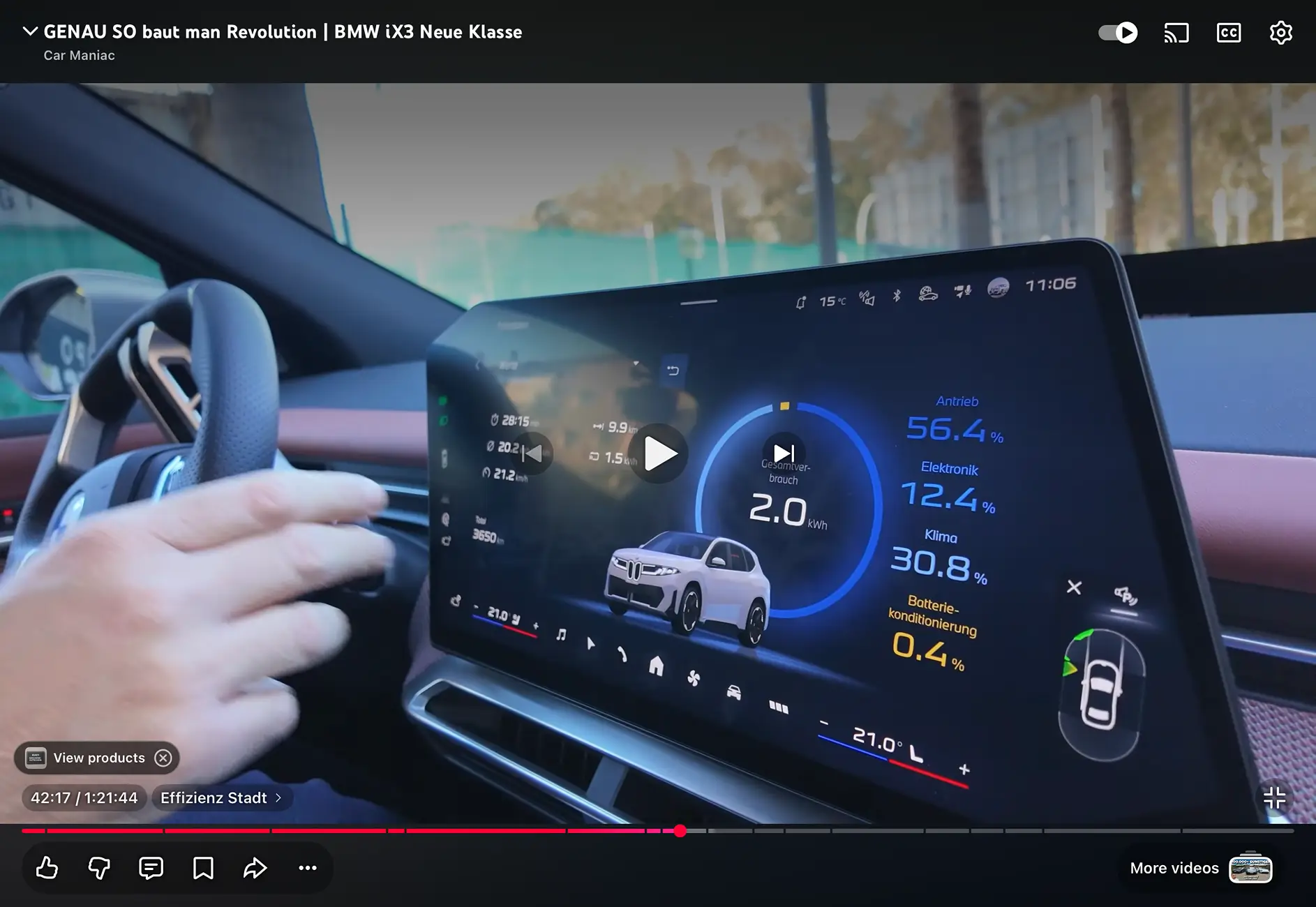
we do not have this for porsche. but the new bmw ix3 neue klasse is using 30%(!!) of its consumption for the AC.
15c outside, AC set to 21 c

Electric Macan EV Preconditioning & charging planner IMG_0185
 
Last edited:

TomekGnomek

Macan 4
Well-Known Member
First Name
Tomek
Joined
Sep 28, 2024
Threads
25
Messages
231
Reaction score
267
Location
Poland
Vehicles
Macan 4
Country flag
we do not habe this for porsche. but the new bmw ix3 neue klasse is using 30%(!!) of its consumption for the AC.
15c outside, AC set to 21 c
30% with AC set to 21C and 15C outside seems like a lot but is the car is stationary?
 
Last edited:


Yves

Macan Turbo
Well-Known Member
First Name
Yves
Joined
Jan 28, 2024
Threads
21
Messages
583
Reaction score
424
Location
Belgium
Vehicles
BMW iX / Macan Turbo
Country flag
30% with AC set to 21C and 15C outside seems like a lot but is the car is stationary?
Yes, filming and so on so yes lots of stationary moments, I see this too when waiting for my children to get from school … the only difference in a Porsche you do not have the stats, so you need to calculate / guess it yourself, Porsche claims users have enough money and do not care so no need to know this. BMW is full of stats, also in the App, but in my iX no battery temp, but that car is 5 years old 🤣
 

seabird

Macan 4S
Well-Known Member
Joined
Feb 18, 2025
Threads
1
Messages
171
Reaction score
192
Location
Earth
Vehicles
Macan 4S, Audi RS5
Country flag
Makes sense but I wonder why my experience in very cold weather has been a bit different with a lot more than 10C added during the approach to the charger (from from 5-10C to well over 20C). Perhaps there are other factors in play like combining high-voltage heater and heat pump, reconfiguring the flow of fluid or air?
It's a good question, and the answer is a combination of factors:
  • Automatic conditioning of the battery in cold temperatures (below freezing, the car doesn't care where it's going and will warm itself)
  • Normal heat accumulation of driving, particularly with a lot of switching back and forth with regen or speeds above 60mph (~5-10C on its own)
  • Contributions of the heat pump in addition to the PTC heater (17kW is the maximum output of all heating combined in the Taycan, but not all of that can go to the battery and the cold the air, the lower the heat pump output as well)
The total heat gain can exceed 10C while driving to a charger, but only roughly 10C of that is coming from the preconditioning cycle specifically.

That extra heat being limited makes sense intuitively--it costs energy to artificially raise the temperature of the battery. A 3kWh cycle eats about 10 miles of your range. In most cases, that energy is better used for maximizing the range of the car. Preconditioning is robbing a little bit of range on a 2-4 hour drive in order to save a little bit of time at a boring charging stop. But it is not going to take a huge chunk of power away to cut your charging time in half, because the cost of doing so would cripple the range of the car.

Using more than 10-15 miles of range doesn't make a lot of sense. No one wants to lose an hour of drive time to "save" 20 minutes charging.
OK, so you never have experienced your self a colder battery and it’s effect on real life charging,
Of course I have. I have driven in temperatures below -20C in Canada. Another wild goose chase on your part. I don't have data on those drives to share here because I can't change the weather on that specific trip.

Your increasingly desperate claims cannot escape the basic physics here. There is no doubt that charging is sometimes slower than expected, but there is equally no doubt that it's not pre-conditioning alone causing that difference. Being mad that sometimes you're not breaking 200kW at 10-30% charge is not something you can solely blame on a preconditioning cycle.

A ~130kW charging rate can happen for a hundred different reasons, such as:
  • A handshake error or charger fault switching to 400V charging (max 135kW)
  • A thermal sensor failure or cooling jacket problem in the cable (max 125kW)
  • A "balanced" or shared charger with another car charging (max ~150kW)
  • A power issue with the battery or capacitor bank at the charging station (anywhere from 60-150kW max)
  • Any number of software communication errors, hardware problems, or grid supply issues
But one reason it absolutely cannot happen is because of an 8-degree temperature difference in the battery.

Preconditioning is something the car does sometimes with a battery temperature between 0 and 15C. That's it. Above 15C, there's no need for it. Below 0C, there's no "pre" conditioning--the battery is going to heat itself no matter what. In between, it will add a little boost with a small fraction of battery power if there is enough time and battery SOC. It's not mandatory. It's not even worth thinking about. Missing out on it is not going to pile up--after just one fast charging session, your battery is going to be conditioned for the rest of that day's drive. It just isn't that big of a deal.

I'm not going round and round with you forever. Your own data confirms the limits of preheating. There's plenty of data out there on the impact of temperature on battery charging and that 10 degrees is not half.
 

Yves

Macan Turbo
Well-Known Member
First Name
Yves
Joined
Jan 28, 2024
Threads
21
Messages
583
Reaction score
424
Location
Belgium
Vehicles
BMW iX / Macan Turbo
Country flag
It's a good question, and the answer is a combination of factors:
  • Automatic conditioning of the battery in cold temperatures (below freezing, the car doesn't care where it's going and will warm itself)
  • Normal heat accumulation of driving, particularly with a lot of switching back and forth with regen or speeds above 60mph (~5-10C on its own)
  • Contributions of the heat pump in addition to the PTC heater (17kW is the maximum output of all heating combined in the Taycan, but not all of that can go to the battery and the cold the air, the lower the heat pump output as well)
The total heat gain can exceed 10C while driving to a charger, but only roughly 10C of that is coming from the preconditioning cycle specifically.

That extra heat being limited makes sense intuitively--it costs energy to artificially raise the temperature of the battery. A 3kWh cycle eats about 10 miles of your range. In most cases, that energy is better used for maximizing the range of the car. Preconditioning is robbing a little bit of range on a 2-4 hour drive in order to save a little bit of time at a boring charging stop. But it is not going to take a huge chunk of power away to cut your charging time in half, because the cost of doing so would cripple the range of the car.

Using more than 10-15 miles of range doesn't make a lot of sense. No one wants to lose an hour of drive time to "save" 20 minutes charging.

Of course I have. I have driven in temperatures below -20C in Canada. Another wild goose chase on your part. I don't have data on those drives to share here because I can't change the weather on that specific trip.

Your increasingly desperate claims cannot escape the basic physics here. There is no doubt that charging is sometimes slower than expected, but there is equally no doubt that it's not pre-conditioning alone causing that difference. Being mad that sometimes you're not breaking 200kW at 10-30% charge is not something you can solely blame on a preconditioning cycle.

A ~130kW charging rate can happen for a hundred different reasons, such as:
  • A handshake error or charger fault switching to 400V charging (max 135kW)
  • A thermal sensor failure or cooling jacket problem in the cable (max 125kW)
  • A "balanced" or shared charger with another car charging (max ~150kW)
  • A power issue with the battery or capacitor bank at the charging station (anywhere from 60-150kW max)
  • Any number of software communication errors, hardware problems, or grid supply issues
But one reason it absolutely cannot happen is because of an 8-degree temperature difference in the battery.

Preconditioning is something the car does sometimes with a battery temperature between 0 and 15C. That's it. Above 15C, there's no need for it. Below 0C, there's no "pre" conditioning--the battery is going to heat itself no matter what. In between, it will add a little boost with a small fraction of battery power if there is enough time and battery SOC. It's not mandatory. It's not even worth thinking about. Missing out on it is not going to pile up--after just one fast charging session, your battery is going to be conditioned for the rest of that day's drive. It just isn't that big of a deal.

I'm not going round and round with you forever. Your own data confirms the limits of preheating. There's plenty of data out there on the impact of temperature on battery charging and that 10 degrees is not half.
Do the test at 15C, mine was and you got the numbers I reported.
I have seen this at my 3 sites that all deliver 300kw or more and I know work without any issue, also my car has no issue as I can repeat this over and over again … 15C or lower and ambient below 15C … no pre conditioning … charge time is 2x slower from 10 to 50-60% and as mentioned the gap is less if you go to 80% as the charge curves start to diverge and meet.
Glad others have the same experience as I do, because in fact I do listen to others and I can be wrong.

On another note I have an ID3GTX with the nice feature that gives your current charging power and charging power at optimal battery condition and a manual pre heating button … I did several tests and yes pre heating takes a long time and it gave me plenty of insights and charging speeds at different heat levels, same result and if Porsche is really serious about being a performance brand they should add that …

Another more serious issue though is that a lot of charging infrastructure shares the 300kw or 400kw between 2 cars and then you have someone that pulls up and decides to take the second handle instead of taking a charger that is completely free … then whatever you do, you are F’ed anyway 😬
 
Last edited:

seabird

Macan 4S
Well-Known Member
Joined
Feb 18, 2025
Threads
1
Messages
171
Reaction score
192
Location
Earth
Vehicles
Macan 4S, Audi RS5
Country flag
Do the test at 15C, mine was and you got the numbers I reported.
You have the answer in this thread.

Charging speed is 36% less efficient at 0C than 25C. It is 12-15% less efficient at 15C than 25C. Not half.

To be 50% less efficient, the battery would need to be over 35C colder, a difference far, far beyond what preconditioning can achieve. Those are the facts. There is nothing more to be said about your unscientific experience involving multiple EV charging factors beyond preheating. I'm sorry you can't come to terms with that.
Sponsored


Top