
- First Name
- Michael
- Joined
- Dec 18, 2024
- Threads
- 25
- Messages
- 279
- Reaction score
- 377
- Location
- Phoenix
- Vehicles
- Macan 4, Macan 4

- Thread starter
- #1
Here are some thoughts after my first long trip in the Macan.
Route: from Prescott, AZ to Telluride, Colorado, 472 miles. First 134 miles was on rural, mountain and high desert highways. Next 127 miles was on US interstate. Final 211 miles was again on mountain and high desert highways. I reversed this route several days later. There was some significant elevation changes on the route, with more uphill on the outbound trip. Both trips were at about 62 mph and 3.1 mi/kWh. The higher consumption was attributable to higher speeds on the interstate (maybe 85-ish mph) and attributable to ascending/descending and curving roads in the mountains.
Charging:
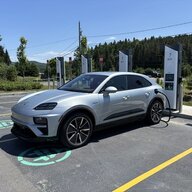
Stop #1, Winslow, AZ, Electrify America, only EV there. Good speed, no issues.
Stop #2, Gallup, NM, Electrify America, only EV there at first, but other three stations filled while there. Good speed, first cable faulted out. Restarted using the second cable on same cabinet and it was fine.
Stop #3: Cortez, CO, Tesla MagicDock. New station, good speed, no issues (had app set up prior to departing on the trip). Charged to higher SOC than required to get to destination (good decision, see below)
Stop #4, Telluride, CO, Tesla, not a MagicDock, but listed as open to non-Tesla (Photos in PlugShare of Rivians, Fords charging there). Not able to charge there. Station didn’t show in Tesla app (you need it to show up in app to initiate charging at the location). Finally realized it was being filtered out by vehicle make (the station showed up if I changed my make to “Rivian” in the app, but it still wouldn’t work). Spent 15 minutes on hold with Tesla and 30 minutes troubleshooting, but the rep was powerless. No matter what I did, I couldn’t get it working.
This was a problem because EV DC charging is sparse in Telluride. There are many destination chargers, most at hotels, but not one at my hotel. One public destination charger was out of service due to local construction on an adjacent building (I was planning on using this one, but no). I couldn’t find a couple of public destination chargers in two different parking garages (although I presume I just didn’t look hard enough). One DC charger didn’t show in PlugShare; I only saw it in the ChargePoint app too late to be of use. I ended up plugged into a free 6.5 kW charger across the street at a grocery store (but was limited to two hours per visit). With an arrival at 41% SOC and a couple of visits to the grocery over three days, I had enough to get back to Cortez on my return trip.
The charging stops on the route were about every 2-2.5 hours and the vehicle was charged and ready to go again before I was. I have to laugh at ICE owners who say EV DC charging is too slow. Not for me in in the Macan.
Planning the charging stops was especially necessary on this trip because there are so few DC chargers in southwestern Colorado mountains once you get off the Interstate. Even so, it was a non-event, other than the issues at the destination, which eventually worked out ok. The various apps, however, need more accurate data.
Innodrive mostly was great. It depended on three things: how curvy the roads are, how well the traffic engineers matched the posted speed to those curves, and how well I adhered to the posted speeds. If I did the posted speeds, Innodrive was really good on these mountain highways. If I didn’t, or if occasionally, rarely, a curve was too tight for the posted speeds, it struggled. Straight Interstate highways were great, of course. I described Innodrive to a friend, saying, “If I do the driving, I have to pay attention at 10 out of 10. With Innodrive, I feel I can be at maybe a 7 out of 10, especially on the straight roads.” It helped reduce fatigue.
Route: from Prescott, AZ to Telluride, Colorado, 472 miles. First 134 miles was on rural, mountain and high desert highways. Next 127 miles was on US interstate. Final 211 miles was again on mountain and high desert highways. I reversed this route several days later. There was some significant elevation changes on the route, with more uphill on the outbound trip. Both trips were at about 62 mph and 3.1 mi/kWh. The higher consumption was attributable to higher speeds on the interstate (maybe 85-ish mph) and attributable to ascending/descending and curving roads in the mountains.
Charging:
Stop #1, Winslow, AZ, Electrify America, only EV there. Good speed, no issues.
Stop #2, Gallup, NM, Electrify America, only EV there at first, but other three stations filled while there. Good speed, first cable faulted out. Restarted using the second cable on same cabinet and it was fine.
Stop #3: Cortez, CO, Tesla MagicDock. New station, good speed, no issues (had app set up prior to departing on the trip). Charged to higher SOC than required to get to destination (good decision, see below)
Stop #4, Telluride, CO, Tesla, not a MagicDock, but listed as open to non-Tesla (Photos in PlugShare of Rivians, Fords charging there). Not able to charge there. Station didn’t show in Tesla app (you need it to show up in app to initiate charging at the location). Finally realized it was being filtered out by vehicle make (the station showed up if I changed my make to “Rivian” in the app, but it still wouldn’t work). Spent 15 minutes on hold with Tesla and 30 minutes troubleshooting, but the rep was powerless. No matter what I did, I couldn’t get it working.
This was a problem because EV DC charging is sparse in Telluride. There are many destination chargers, most at hotels, but not one at my hotel. One public destination charger was out of service due to local construction on an adjacent building (I was planning on using this one, but no). I couldn’t find a couple of public destination chargers in two different parking garages (although I presume I just didn’t look hard enough). One DC charger didn’t show in PlugShare; I only saw it in the ChargePoint app too late to be of use. I ended up plugged into a free 6.5 kW charger across the street at a grocery store (but was limited to two hours per visit). With an arrival at 41% SOC and a couple of visits to the grocery over three days, I had enough to get back to Cortez on my return trip.
The charging stops on the route were about every 2-2.5 hours and the vehicle was charged and ready to go again before I was. I have to laugh at ICE owners who say EV DC charging is too slow. Not for me in in the Macan.
Planning the charging stops was especially necessary on this trip because there are so few DC chargers in southwestern Colorado mountains once you get off the Interstate. Even so, it was a non-event, other than the issues at the destination, which eventually worked out ok. The various apps, however, need more accurate data.
Innodrive mostly was great. It depended on three things: how curvy the roads are, how well the traffic engineers matched the posted speed to those curves, and how well I adhered to the posted speeds. If I did the posted speeds, Innodrive was really good on these mountain highways. If I didn’t, or if occasionally, rarely, a curve was too tight for the posted speeds, it struggled. Straight Interstate highways were great, of course. I described Innodrive to a friend, saying, “If I do the driving, I have to pay attention at 10 out of 10. With Innodrive, I feel I can be at maybe a 7 out of 10, especially on the straight roads.” It helped reduce fatigue.
Sponsored