
• Welcome to MacanEVowners! If you're joining us from Taycanforum.com, then you may already have an account here.

    If you were registered on Taycanforum as of January 24, 2024 or earlier, then you can simply login here with the same username and password

    If you wish, you can remove your account here.
Sponsored

daveo4EV

Macan Turbo
Well-Known Member
First Name
David
Joined
Jan 28, 2019
Threads
76
Messages
1,504
Reaction score
2,419
Location
Santa Cruz
Vehicles
Macan Turbo,Cayenne Hybrid, 911(s) GT3/Convertable
Country flag
Can someone please explain the error in my thinking that Tesla Superchargers are the most hyped and least powerful chargers of the modern set of DCFC CPOs?

1. V3 cabinets (500VDC max) are 360kW shared across 4 units with potential site DC bus bar but still it’s 90kW per vehicle if fully occupied and 180 at 50%. Tesla have a fairly poor charging curve and thus these restrictions are not so noticed. Now, with other vehicles, charging there that have substantially more robustness to absorb power, these limitations will be very visible.
2. The elusive V4 cabinets (1000VDC max) are 1MW shared across 8 chargers (1.2mW for truck stations). They don’t support a DC bus bar thus each set of 8 will derate to 125kW if fully utilized.
3. The one and only V4 site in Redwood City still has dispensers covered up, theoretically to limit the potential derating. Also, I don’t foresee Tesla wanting to spend so much money upgrading their chargers to 1000 V when the only vehicle they sell that would be enhanced by. This is the cyber truck which has very limited sales. And with their amperage boost on V4 dispenser is on the three cabinets to 325 kW I feel they may see the problem as already solved for their ecosystem.
4. Handle overheating and derating is still an issue. Even on the latest Easter Edge race by Out of Spec they were poring water on handles. I do think non-Tesla suppliers of J3400 handles may have solved the cooling issues. To be seen on IONNA charging a 500+Amp NACS/J3400 vehicle that has a good curve.
easy one network most works most of the time

the other networks don't

the spec's dont' matter if the charging stall is broken or can't activate a session or you have to wait because of congestion - and there is often "enhanced" congestion - i.e. you wouldn't have had to wait for open stall if all the stalls were actually operational…

also you rarely if ever get the the actual max charge rate at the 800V stations - I can count on 2 hands the number of times I've actually experienced a true optimal 800V session - the vast majority of my charging session meander around the 150 kW rate or less due to a large number of variables…

I've owned an 800V EV since July of 2020 - I've gotten a charge rate of over 150 kW less than 10 times in well over 150 charging session - but I've gotten 0 kW charge rate at many many CCS stations that simply were non-operational…the CCS stations fail to operate entirely much much more often than they provide an enhanced charging speed…
you're focusing on theory - others are focusing on actual experience

the supercharger network provably scales and offers a better experience than a non-operational congested CCS stations with 2 of 6 stalls actually operational…

also the performance "advantage" of the 800V stations is completely lost if you have _ONE_ technical hicup - its very very very easy to lose 5-6 minutes fussing with what turns out to be a non-operational station…or setting up an account or having a charge not go through - or having a session timeout while trying to handshake - or simply moving the car to another stall…

the performance advantage of 800V stations is more perishable than the freshest of strawberry's - you have about a 10 minute window where the 800V session will be 'faster' than 400V stations - after that both types of stations offer similar if not identical charging speeds…and if you pull in at 30% SOC or above that window is even smaller…or your battery is at the wrong temp - or the stations is balanced…

800V stations have _ONE_ shot to offer an actual faster charging stop than 400V stations - the conditions for success are narrow and fraught with incompetence and enviromental conditions outside of your control…if you have to take a mulligan on an 800V charging session you've already lost in terms of over actual time spent stopped trying to charge an EV.

if you're pulling into a station at 40% or above SOC - there is _NO_ advantage in terms of charging speed - and I've seen many many EV owners do this…

the conditions for 800V charging to actually be "faster" are narrow, difficult to achieve, fleeting, and easily derailed.

the criteria for success must be measured in terms of: total # of times plugged into a 800V charging stalls - total # of times you actually achieved a "faster" charge rate…

i've done two road trips with my 2024 Macan EV - both published with data on this forum
  • Nov. 2024 - 800V "success" rate - 20% "faster" - 80% normal or slower - 20 charging trials
  • July 2025 - 800V "success" rate - 0% faster - 100% normal or slower - 10 charging trial
so on two separate road trips - where supercharging was not an option - so I was using pure CCS charging stalls most of which were EA stations offering 800V charging - 4 out of 30 attempts achieved faster than 400V charging speeds - or a success rate of…

4 /30 = 13% - 87% of the time the 800V CCS stations was no faster than supercharging

but that stat above do NOT include the CCS flaky-ness factor or the number of outraight failures of a given CCS stall/station being non-operational - which would make the "success" rate even less impressive.

consistent mediocrity beats flaky performance every time…
Sponsored

 
Last edited:

daveo4EV

Macan Turbo
Well-Known Member
First Name
David
Joined
Jan 28, 2019
Threads
76
Messages
1,504
Reaction score
2,419
Location
Santa Cruz
Vehicles
Macan Turbo,Cayenne Hybrid, 911(s) GT3/Convertable
Country flag
from my trip report when picking up the Macan EV from PECATL…

https://www.macanevowners.com/forum/threads/trip-report-im-peddling-as-fast-as-i-can-to-generate-electrons…-pec-atl-to-santa-cruz-in-a-macan-ev-turbo.17948/page-14#post-273395

20 charging stops - 2500 miles - NO SUPERCHARGERS (was not an option) - 4 charging session achieved a max charging speed greater than 400V/supercharger session - many many failed attempts

out of 20 real world trials - on a real world road trip - 4 'successful' sessions - 16 sessions at 800V stations that were no faster than supercharging…20% success rate - 80% failure rate in terms of being "faster" than a supercharger…

from my summer 2025 Road trip - https://www.macanevowners.com/forum...pacific-northwest-family-wedding.22048/page-2

10 800V charging stops from my charging table - zero charging session that achieved a faster charge rate than supercharging…100% failure to be "faster" because it was an 800V session.

my real world experience and data shows no statistically significant advantage in 800V charging sessions with actual charging speeds being similar or identical to supercharger speeds - and that's before you factor in the "failed" session count or mulligans when dealing with CCS stations…

my $0.02 YMMV.
 

dbsb3233

Macan Base
Well-Known Member
First Name
Tim
Joined
Jun 13, 2025
Threads
11
Messages
252
Reaction score
182
Location
Colorado
Vehicles
2021 Ford Mustang Mach-E FE, 2025 Porche Macan Electric
Country flag
consistent mediocrity beats flaky performance every time…
I wouldn't say every time. It just depends. For instance, we drive between Denver and Las Vegas every other month. We're still on out first year of free EA so we're using it whenever possible. The EA station on I-70 at Ivie Creek UT rest area has the newer EA chargers. We've had nothing but perfect charges there. Max power the car will take for every point in the charging curve. But the other 3 EA stations we typically use on the route are the older chargers that have the usual hit&miss challenges. The best we usually get out of those is 173kw on a 150 charger. We can rarely get on a 350, and it's rare to get 200+ if we do.

But even when unable to get full power at EA, we're still usually getting more than the 135kw max the Macan will do at SCs. So we'd still usually favor EA (or Ionna now since there's 2 stations on that route) over SCs. SCs remain a welcome backup for us at this point. Knowing there's a backup in range helps in giving EA a try first, ironically. But again, it depends on the station, and perhaps the region as you've noted about the west coast.
 

daveo4EV

Macan Turbo
Well-Known Member
First Name
David
Joined
Jan 28, 2019
Threads
76
Messages
1,504
Reaction score
2,419
Location
Santa Cruz
Vehicles
Macan Turbo,Cayenne Hybrid, 911(s) GT3/Convertable
Country flag
let's do a mental exercise - let's not focus on "speed" let's focus on reliability…

you pull into an empty parking lot…
on your left there are 16 V3/V4 supercharges - un-occupied - you can pick your stall - no congestion
on your right there a 4 EA CCS stations - un-occupied - you can pick your stall - but can't see the screens to see their status

you can plug in _ONCE_ and only once to achieve a charging session…

which direction do you turn the car?

based on my _PERSONAL_ experience with fast charging since 2012 - I'm turning left because the supercharger is more likely to work vs. the EA stations…neither option guarantees success - but one side has a clear advantage…
 

dbsb3233

Macan Base
Well-Known Member
First Name
Tim
Joined
Jun 13, 2025
Threads
11
Messages
252
Reaction score
182
Location
Colorado
Vehicles
2021 Ford Mustang Mach-E FE, 2025 Porche Macan Electric
Country flag
let's do a mental exercise - let's not focus on "speed" let's focus on reliability…

you pull into an empty parking lot…
on your left there are 16 V3/V4 supercharges - un-occupied - you can pick your stall - no congestion
on your right there a 4 EA CCS stations - un-occupied - you can pick your stall - but can't see the screens to see their status

you can plug in _ONCE_ and only once to achieve a charging session…

which direction do you turn the car?

based on my _PERSONAL_ experience with fast charging since 2012 - I'm turning left because the supercharger is more likely to work vs. the EA stations…neither option guarantees success - but one side has a clear advantage…
Sure, if there's some rule that only allows me one chance to plug in or else get stranded, I'm picking the highest change of success over speed (or price).

Fortunately that rule doesn't actually exist.

In probably 300 lifetime EA chargers, I've only had to leave a station without a charge to bail out at another one maybe 5 times. Maybe on a quarter of those the extra fuss time would have made it faster just going to the SC first (if the 800V Macan were the car in all those). But the other 3/4th the EA would still be faster.

But again, that depends a lot on how good/bad EA is in the region you're traveling thru. The west coast sounds worse than what I've experienced in flyover country. In fact, many times we don't even have that choice. There's still so many V2 stations in WY, NV, SD, and other places out here that it's not even a viable choice in many places. Slowly seeing some upgrades (like Green River UT that really needed an EA backup for CCS drivers), but there's still a lot of V2s.

There is no right or wrong choice for everyone here. It just depends.


ron_b

Macan 4
Well-Known Member
First Name
Ron
Joined
Dec 30, 2019
Threads
7
Messages
59
Reaction score
87
Location
California Central Coast, USA
Vehicles
2026 Macan 4 (waiting at dock), 2020 Taycan 4S
Country flag
I realize this is a Macan forum, but to address one of my friend @daveo4EV criticisms on getting good speeds on 800v charging sessions especially EA I ask if I may use data collected from my Taycan ownership.

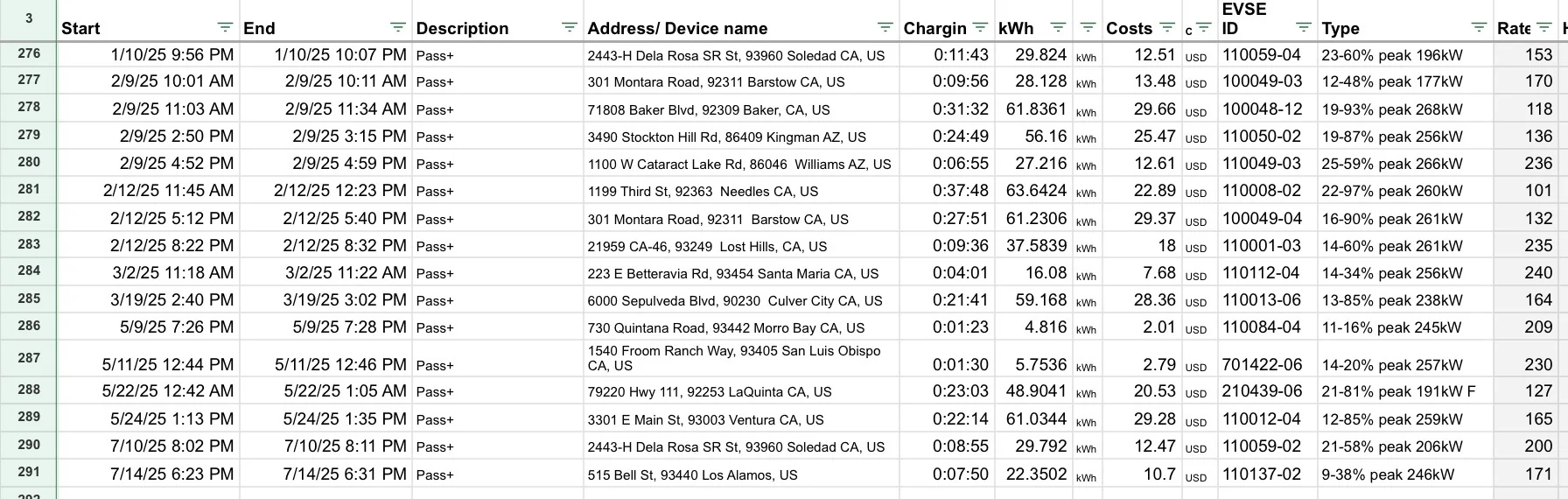
During my 5.5 years with the car and 105k miles I had recorded every charging session L2 (788 sessions) and DCFC (640 sessions). Filtering to only DCFC on EA I have 602 total sessions. Further filtering to sessions starting at 25% SoC or less (and removing sessions where starting SoC was not recorded) I have 276 sessions.

I recorded peak power only once my Taycan Inclusive plan ran out and the EA app showed Peak charging rate within the app in session history. That was a mere 16 sessions from 2025 and of those, 13 peaked at 200kW or better and 15 peaked at 190kW or better. Realize that this is on a 5 year old Taycan. Session details attached.
Electric Macan EV Plug & Charge now available for Tesla Superchargers via Porsche Charging Service IMG_0195


Now of the remaining 260 sessions I do not have a recorded peak but only a percentage range and kWh and duration to the minute. Excluding sessions where ending SoC was over 70% so that looking at average charging speed is relevant this yields 127 sessions and of those 76 sessions averaged over 150kW and 40 sessions averaged over 175kW. Note that the 40 sessions were across 18 different EA locations in 6 different States.

I am sorry that Dave has such consistently poor success getting good charging sessions. I have had many derated sessions and some cold batteries but at least 75% of the time I did well charging at 1000V capable EA chargers.

I will happily use other CPO’s thousand volt chargers now that there are so many options. I will use Tesla SCs if I’m stuck.
 

pdealessandrini1930

Macan 4
Well-Known Member
First Name
Paolo
Joined
Jan 26, 2025
Threads
0
Messages
95
Reaction score
78
Location
Montauk, NY
Vehicles
2024 Macan 4 EV, 2021 Macan S, 2016 911 GTS PCA 60th Anniversary
Country flag
Will there be anyway to get the discounted pricing from a Tesla app subscription? Was looking at a long road trip this summer, and feel like it pays for itself quite quickly.
Hi to All -

My experience- like everyone’s- is cheapest charging is at home. That said it’s only 9kWh speed, so overnight. For long commutes or road trips, EA and Tesla are my options.

Pricing may vary across regions of the US.

NY State observation:
1. EA stations are close (2 miles) to my primary commute destinations.
- non membership cost $0.60/kWh
- Membership $7/mo = $0.36/kWh
- given daily and weekend commutes, have membership and saved bundles.
2. Tesla charging stations are significantly more abundant making them a safer bet once I start traveling for vacation trips.
- non membership $0.53-$0.60/kWh in my local areas
- membership $12.99/mo = $0.38/kWh
3. Chargepoint:
- no membership fee needed, just account with credit card payment set up. Average $0.30/kWh but slow like at home: 9kWh speed. Flawless experience but good for overnight not travel or daily commuting unless I can leave plugged in overnight.

EA takes time for handshake And more often a station is unresponsive requiring call to customer service to reboot charging station. Tesla does not and stations are faster speeds than EA in my areas.
 

daveo4EV

Macan Turbo
Well-Known Member
First Name
David
Joined
Jan 28, 2019
Threads
76
Messages
1,504
Reaction score
2,419
Location
Santa Cruz
Vehicles
Macan Turbo,Cayenne Hybrid, 911(s) GT3/Convertable
Country flag
I realize this is a Macan forum, but to address one of my friend @daveo4EV criticisms on getting good speeds on 800v charging sessions especially EA I ask if I may use data collected from my Taycan ownership.

During my 5.5 years with the car and 105k miles I had recorded every charging session L2 (788 sessions) and DCFC (640 sessions). Filtering to only DCFC on EA I have 602 total sessions. Further filtering to sessions starting at 25% SoC or less (and removing sessions where starting SoC was not recorded) I have 276 sessions.

I recorded peak power only once my Taycan Inclusive plan ran out and the EA app showed Peak charging rate within the app in session history. That was a mere 16 sessions from 2025 and of those, 13 peaked at 200kW or better and 15 peaked at 190kW or better. Realize that this is on a 5 year old Taycan. Session details attached.
IMG_0195.webp


Now of the remaining 260 sessions I do not have a recorded peak but only a percentage range and kWh and duration to the minute. Excluding sessions where ending SoC was over 70% so that looking at average charging speed is relevant this yields 127 sessions and of those 76 sessions averaged over 150kW and 40 sessions averaged over 175kW. Note that the 40 sessions were across 18 different EA locations in 6 different States.

I am sorry that Dave has such consistently poor success getting good charging sessions. I have had many derated sessions and some cold batteries but at least 75% of the time I did well charging at 1000V capable EA chargers.

I will happily use other CPO’s thousand volt chargers now that there are so many options. I will use Tesla SCs if I’m stuck.
@ron_b knows I love me some data!!! good job Ron - wow you've had much much much better luck with 800V sessions than I have…but you also have more detailed data…maybe it knows you're watching!!!!

I'll dig into the data in a bit - I don't think it's the compelling case you think it is…

this Taycan data is impressive
 
Last edited:

daveo4EV

Macan Turbo
Well-Known Member
First Name
David
Joined
Jan 28, 2019
Threads
76
Messages
1,504
Reaction score
2,419
Location
Santa Cruz
Vehicles
Macan Turbo,Cayenne Hybrid, 911(s) GT3/Convertable
Country flag
hmmm trying to get to a summary

TLDR; out of 602 EA 800V sessions across more than 5 years - less than 3% of the session were 800V "optimal" (200 kW and above) - and only 7% were 800V "beneficial" (175 kW and above) - a whopping 93% (559) of EA sessions were not statistically/significantly faster than a run of the mill 150 kW charging session…​
93% of the time 800V did not matter - 559 out of 602 charging sessions.​

I show my work below from the data set…


During my 5.5 years with the car and 105k miles I had recorded every charging session L2 (788 sessions) and DCFC (640 sessions). Filtering to only DCFC on EA I have 602 total sessions. Further filtering to sessions starting at 25% SoC or less (and removing sessions where starting SoC was not recorded) I have 276 sessions.
the facts from the data…
  • 640 FastDC charging session (impressive)
  • 602 session on EA
  • once you filter for sessions that are less than 25% SOC (the ideal candidate sessions) - we arrive at 276 session that "could be ideal candidates" for 800V charging advantages - that means already 326 sessions or 54% of the total charging sessions 800V doesn't matter or the potential "win" is inconsequential because of the high SOC and impact on the charging taper curve…
initial conclusion from the data presented:

276 (possible fast charging sessions) / 640 FastDC sessions is 43% of your potential FastDC charging sessions would benefit from > 150 kw (if available) - less than 1/2 of the time you charged at a fastDC charging station

across 602 real world charging sessions more than 50% the time 800V charging would not and did not matter in the real world
let's continue…

Now of the remaining 260 sessions I do not have a recorded peak but only a percentage range and kWh and duration to the minute. Excluding sessions where ending SoC was over 70% so that looking at average charging speed is relevant this yields 127 sessions and of those 76 sessions averaged over 150kW and 40 sessions averaged over 175kW. Note that the 40 sessions were across 18 different EA locations in 6 different States
of the 276 session - 127 sessions were "800V fast" (> 150 kW)…and only 40 sessions were "really fast" > 175 kW

76 of those sessions were greater than 150 kW - so 60% (76/127)
40 of those sessions were greater than 175 kW - so 31% (40/127)

but really we need to evaluate how often for any given FastDC 800V charging mattered…

the experience across 5 years is not just the 127 sessions that were potentially fast - it's how often did 800V charging matter across all the times you FastDC charged - and that number 602 FastDC charging sessions at EA…

so we need to evaluate how often you benefited from 800V charging rates across all your potential FastDC charging sessions…

for that we need to return to the original 602 sessions on EA (or 640'ish total FastDC charging sessions) - so the facts are:
  • 127 / 602 = 21% of the time you plugged into a FastDC charging station it "mattered" - the other 79% of the time any 150 kW fastDc charger would yield similar results
  • of the 127 "800V fast sessions" out of 602 real world trials - 40 were greater than 175 kW…
  • or 40 / 602 = 0.066 or about 7%
so across 602 sessions in 5'ish years - 7% of the time it mattered that you were plugged into an 800V station and achieved more than 175 kW charge rate - of all your sessions (and impressive number BTW) 93% of your charging sessions were less than 175 kW (for various reasons) and therefore barely faster than a normal 150 kW session…

less than 10% of the time did 800V charging achieve any significant benefit over nominal 150 kW/400V charging…if we define signficant as 175 kW charge rate achieved (and I'd argue this is not a bad cutoff) - below 175 kW any "gain" above 150 kW nominal is statistically insignificant and easily overwhelmed by trivial non-charging related delays
this entire analysis is also ignoring EA failure modes/problems which was not represented in the data presented - if we included any EA "issues" encountered across 602 candidate charging sessions I would suggest the data paints a less pleasant picture -it's hard to believe that in 602 sessions there were not some problems in some large number of those 602 trials…

across all 602 charging sessions 800V charging mattered/played-a-role 7% of the time…93% of the time similar charging sessions durations would've been achieved at a run of the mill 400V session…

and in that same data set "optimal" 800V charging was achieved 16 times…

16 / 602 =0.0266 or 2.6% of the time 97.4% of the time the charging sessions were sub-optimal due to the circumstances of the charging session…

93% (559 session out of 602) of the time 800V charging did not matter in 5 years across 602 "trial" charging sessions…

at least that's what the data is telling me…

bottom line across all FastDC charging sessions in 5 years and 602 EA charging sessions:
  • 2.6% (16) of the 602 charging sessions achieved optimal (200 kW or greater)
  • 7% (40) of the 602 sessions were "signficantly" faster or equal to 175 kW charge rate…
  • but a whopping 93% (559 times) of the 602 EA sessions were less than 175 where one could argue (and I am arguing) that a nominal 150 kW charging session would be inconsequentially different…
based on the date presented above 800V does not matter over 92% of the time…

9 of 10 charging session 800V optimal charging doesn't matter…this data also does not reflect "failed attempts' or "EA frustration" with problems, stations out of comission, the retry rate for actually starting a session - an interesting statistics would be:

"did it work" on the first attempt? because if it doesn't work on the 1st plug-in attempt then you've lost the 800V "advantage"…because the charge session retry eats into the 800V advantage time delta…​

the data also does not reflect the hand-shake start up time (which in my experince cant take up to 2 minutes at some EA sites before electrons are actually flowing)

but 93% of the time there was no advantage to 800V charging based on charge rate/speed actually achieved during the charging session…

the numbers get even worse if you include the "real" number of raw FastDC charging sessions (640)

I'll return to my mantra which is charging reliability - I, in my travels will optimize for "works the first time" plug it in - based on my experience EA is not that network - other options are more likely to work the first time you plug in - based on the data presented above from 602 real world EA charging sessions 800V charging did not matter 559 times - any old FastDC charger would have achieved similar charging session results - at that point in time any major time savings is going to be achieved by not having to "re do" the charging session - not the speed that will be achieved during the charging session - but reducing the overhead of getting a charging session started…

my conclusion from the data presented:

800V ideal/optimal charging session were achieved less than 3% of the time out of 602 charging sessions - I don't carry an umbrella with me if there is a 3% or less chance of rain…97% of the time you will not (or can not) achieve an optimal 800V session…I would suggest you plan accordingly and look for other potential characteristics that will elongate your time spent charging…for me that means trying to make sure the charging session will activate on the first attempt - in my experience this is the biggest time savings available to EV road warriors and heaven help you if you have the move the car to another stall…​
this is inline with my previous assertion:​
the performance advantage of 800V stations is more perishable than the freshest of strawberry's - you have about a 10 minute window where the 800V session will be 'faster' than 400V stations - after that both types of stations offer similar if not identical charging speeds…and if you pull in at 30% SOC or above that window is even smaller…or your battery is at the wrong temp - or the stations is balanced…

800V stations have _ONE_ shot to offer an actual faster charging stop than 400V stations - the conditions for success are narrow and fraught with incompetence and enviromental conditions outside of your control…if you have to take a mulligan on an 800V charging session you've already lost in terms of over actual time spent stopped trying to charge an EV.
the 800V success rate (by way of an actual charging speed advantage delivered) represented by this data (602 actual EA charging sessions) I would suggest backs up my assertions.
 
Last edited:


daveo4EV

Macan Turbo
Well-Known Member
First Name
David
Joined
Jan 28, 2019
Threads
76
Messages
1,504
Reaction score
2,419
Location
Santa Cruz
Vehicles
Macan Turbo,Cayenne Hybrid, 911(s) GT3/Convertable
Country flag
hmmm trying to get to a summary


the facts from the data…
  • 640 FastDC charging session (impressive)
  • 602 session on EA
  • once you filter for sessions that are less than 25% SOC (the ideal candidate sessions) - we arrive at 276 session that "could be ideal candidates" for 800V charging advantages - that means already 326 sessions or 54% of the total charging sessions 800V doesn't matter…
initial conclusion:


let's continue…


of the 276 session - 127 sessions were "800V fast" (> 150 kW)…and only 40 sessions were "really fast" > 175 kW

76 of those sessions were greater than 150 kW - so 60% (76/127)
40 of those sessions were greater than 175 kW - so 31% (40/127)

but really we need to evaluate how often for any given FastDC 800V charging mattered…

the experience across 5 years is not just the 127 sessions that were fast - it's how often did 800V charfging matter across all the times you FastDC charged - and that number 602 FastDC charging sessions at EA…

so we need to evaluate how often you benefited from 800V charging rates across all your potential FastDC charging sessions…

for that we need to return to the original 602 sessions on EA (or 640'ish total FastDC charging sessions) - so the facts are:
  • 127 / 602 = 21% of the time you plugged into a FastDC charging station it "mattered" - the other 79% of the time any 150 kW fastDc charger would yield similar results
  • of the 127 "800V fast sessions" out of 602 real world trials - 40 were greater than 175 kW…
  • or 40 / 602 = 0.066 or about 7%


this entire analysis is also ignoring EA failure modes/problems which was not represented in the data presented - if we included any EA "issues" encountered across 602 candidate charging sessions I would suggest the data paints a less pleasant picture -it's hard to believe that in 602 sessions there were not some problems in some large number of those 602 trials…

across all 602 charging sessions 800V charging mattered/played-a-role 7% of the time…93% of the time similar charging sessions durations would've been achieved at a run of the mill 400V session…

and in that same data set "optimal" 800V charging was achieved 16 times…

16 / 602 =0.0266 or 2.6% of the time 97.4% of the time the charging sessions were sub-optimal due to the circumstances of the charging session…

93% (559 session out of 602) of the time 800V charging did not matter in 5 years across 602 "trial" charging sessions…

at least that's what the data is telling me…

bottom line across all FastDC charging sessions in 5 years and 602 EA charging sessions:
  • 2.6% (16) of the 602 charging sessions achieved optimal (200 kW or greater)
  • 7% (40) of the 602 sessions were "signficantly" faster or equal to 175 kW charge rate…
  • but a whopping 93% (559 times) of the 602 EA sessions were less than 175 where one could argue (and I am arguing) that a nominal 150 kW charging session would be inconsequentially different…
based on the date presented above 800V does not matter over 92% of the time…

9 of 10 charging session 800V optimal charging doesn't matter…this data also does not reflect "failed attempts' or "EA frustration" with problems, stations out of comission, the retry rate for actually starting a session - an interesting statistics would be:

"did it work" on the first attempt? because if it doesn't work on the 1st plug-in attempt then you've lost the 800V "advantage"…because the charge session retry eats into the 800V advantage time delta…​

the data also does not reflect the hand-shake start up time (which in my experince cant take up to 2 minutes at some EA sites before electrons are actually flowing)

but 93% of the time there was no advantage to 800V charging based on charge rate/speed actually achieved during the charging session…

the numbers get even worse if you include the "real" number of raw FastDC charging sessions (640)

I'll return to my mantra which is charging reliability - I, in my travels will optimize for "works the first time" plug it in - based on my experience EA is not that network - other options are more likely to work the first time you plug in - based on the data presented above from 602 real world EA charging sessions 800V charging did not matter 559 times - any old FastDC charger would have achieved similar charging session results - at that point in time any major time savings is going to be achieved by not having to "re do" the charging session - not the speed that will be achieved during the charging session - but reducing the overhead of getting a charging session started…

my conclusion from the data presented:

800V ideal/optimal charging session were achieved less than 3% of the time out of 602 charging sessions - I don't carry an umbrella with me if there is a 3% or less chance of rain…97% of the time you will not (or can not) achieve an optimal 800V session…I would suggest you plan accordingly and look for other potential characteristics that will elongate your time spent charging…​
this is inline with my previous assertion:​


the 800V success rate (by way of an actual charging speed advantage delivered) represented by this data (602 actual EA charging sessions) I would suggest backs up my assertions.
all this being said…

it _IS_ enormously satisfying to see/experience 260 kW (or greater) charge rates with both my 2020 Taycan Turbo and my current 2026 Macan EV Turbo - I have achieved these "optimal" 800V charging sessions a handful times (4 times in my initial road trip after PECATL delviery of the Macan Turbo EV)…

that being said in my 5+ years with 800V EV's (Taycan and Macan) I've only achieved these glorious results a handful of times - with the vast majority of charging sessions meandering at 180 kW or below…sometimes significantly below.

but the potential charging speeds of 800V @ 270 kW or greater is simply intoxicating and when achieved makes the EV nerd/engineer in me sooooo happy and giddy…

I understand and sympathize with the aspirations of 800V charging - but OMG it is simply so hard to actually achieve it's almost not worth even trying…

I see the 800V/270kW (or more) charging statistics a bit like I evaluate Porsche's "ring time" benchmarks - these numbes are aspirational and do represent the technical capabilities of the vehicle. They are factual, and represent actual engineering and I have no doubt that the results are achievable and they can be used to evaluate if Porsche's latest offering is "better" than previous vehicles or better than competitive vehicles…

But these numbers are achieved in highly controlled circumstances and with professional drivers and the one successful result is never presented in the context of number the un-successful attempts (hint there are 100's of attempts for any given 1 ring lap time) - they are actual results that can be achieved. But that doesnt' mean I can go to the ring and achieve similar results - there are simply sooooo many variables both in and outside of my control that it's simply not feasible or practical to actual expect that sort of performance for any given trial…it just means it's possible under the right circumstances.​

my sincere hope is that 800V charging continues to improve in both reliability of activating a session but also in actualy delivering on the potential…we'll see how this plays out.
 
Last edited:

USMA81

Macan 4
Well-Known Member
First Name
Michael
Joined
Dec 18, 2024
Threads
19
Messages
234
Reaction score
305
Location
Phoenix
Vehicles
Macan 4, Macan 4
Country flag
My experience is better. I don’t have the detailed data, but anecdotally I’m getting higher rates about 50% of the time on EA stations when my SOC is low and the charging curve would support it. It is, however, a bit of a mystery when I will get it and not: I‘m the only vehicle and I get a slow rate, or, I got a slow rate at the same station that today gives me 260 kW. My default is EA or other 800 V first, and Tesla as backup, but the total difference in time over the long run is likely not significant.
 

dbsb3233

Macan Base
Well-Known Member
First Name
Tim
Joined
Jun 13, 2025
Threads
11
Messages
252
Reaction score
182
Location
Colorado
Vehicles
2021 Ford Mustang Mach-E FE, 2025 Porche Macan Electric
Country flag
1. EA stations are close (2 miles) to my primary commute destinations.
- non membership cost $0.60/kWh
- Membership $7/mo = $0.36/kWh
- given daily and weekend commutes, have membership and saved bundles.
2. Tesla charging stations are significantly more abundant making them a safer bet once I start traveling for vacation trips.
- non membership $0.53-$0.60/kWh in my local areas
- membership $12.99/mo = $0.38/kWh
Those don't seem quite right, or would be unusual. Typically both the EA and SC membership discounts are roughly 25% off. An EA station that's 60c base price would usually be ~45c with the discount. 48c would usually be ~36c with discount.

SCs vary a bit more. For instance, one random one I just looked up is 50c base price and 36c discount. For SCs, you can see both the base and discount rates on the website:

https://www.tesla.com/findus?bounds...,nacs_superchargers,coming_soon_superchargers
 

pdealessandrini1930

Macan 4
Well-Known Member
First Name
Paolo
Joined
Jan 26, 2025
Threads
0
Messages
95
Reaction score
78
Location
Montauk, NY
Vehicles
2024 Macan 4 EV, 2021 Macan S, 2016 911 GTS PCA 60th Anniversary
Country flag
Those don't seem quite right, or would be unusual. Typically both the EA and SC membership discounts are roughly 25% off. An EA station that's 60c base price would usually be ~45c with the discount. 48c would usually be ~36c with discount.

SCs vary a bit more. For instance, one random one I just looked up is 50c base price and 36c discount. For SCs, you can see both the base and discount rates on the website:

https://www.tesla.com/findus?bounds=42.09027247332726,-100.3976269453125,36.66863769207266,-116.21793944531248&filters=open_to_all_evs_superchargers,nacs_superchargers,coming_soon_superchargers
Hi. thanks for your additional insight.

to be clear, the pricing with and without memberships I cited for EA and Tesla are specifically from my memberships and billing summaries. not general assumptions.

hence, I stand by my data, with proviso I noted, that these prices I shared are based my account being in NY state and the chargers and pricing are for those in my region.

Surely the prices vary nationally.
cheers,
 

ron_b

Macan 4
Well-Known Member
First Name
Ron
Joined
Dec 30, 2019
Threads
7
Messages
59
Reaction score
87
Location
California Central Coast, USA
Vehicles
2026 Macan 4 (waiting at dock), 2020 Taycan 4S
Country flag
  • 127 / 602 = 21% of the time you plugged into a FastDC charging station it "mattered" - the other 79% of the time any 150 kW fastDc charger would yield similar results
  • of the 127 "800V fast sessions" out of 602 real world trials - 40 were greater than 175 kW…
  • or 40 / 602 = 0.066 or about 7%
@daveo4EV I realize you are critiquing my filtering of the 602 EA charging sessions and I am open to that; however, I think you are miss reading or misinterpreting my kilowatt ratings.
  • Only the 16 sessions do I have high Fidelity peak speed values that I could share. Also, you can see my typical charing range as far as starting and ending state of charge.
  • For the remainder of the sessions, I had no peak values and for a vast number I did not have starting an ending percentages at all (as I did not record that until the middle of my ownership which I used to project battery capacity), thus I had to filter to 276 sessions. Note: The number of excluded sessions because they started over 25% SoC were a relatively small and I will concede that those sessions could’ve easily buttoned done at a 400 V unit for the Macan with no noticeable penalty in charging time.
  • As for 260 filtering to 127, this is not to imply that the excluded 133 sessions did not have a high peak speed, it is simply too attempt to extrapolate peak speeds by looking at average speeds. The charging rate when charging above 70% becomes highly throttled and thus I felt it non-meaningful to include that data. I can neither confirm nor deny the exploitation of 800 V chargers in those cases. I think it would be reasonable to assume that the percentages seen in other data would be indicative.
  • The 76 sessions (60%) averaging over 150kW is probably enhanced by 800v as realize as I’m sure you do Dave that the charging curve diminishes after 55 to 60% and thus to maintain a 150 kW average for sessions starting below 25% and going up to a maximum of 70% would typically yield peak speeds in the neighborhood of 200 kW.
  • The 40 sessions (31%) averaging over 175 kW is definitely enhanced by 800 V charging.
  • As far as how many minutes are saved on a session, though I can’t imagine doing the analytics necessary for at least the 16 sessions that I have more fidelity. It would be quite time-consuming. I think it would typically be between 5 to 10min. But when you’re doing a road trip and four charging stops in a day, I do want to minimize any delays.
  • I can’t comment on EA handshake time definitively as I do not log that, however my feelings are that it was about a 30sec average.

Reliability of chargers, I agree that I have seen many broken Electrify America chargers. I do not have personal experience with Tesla superchargers yet. However; watching the Out of Spec Studios eastern edge videos I see the number of times they get derated speeds and a few dysfunctional chargers when using Tesla Superchargers. So I don’t know where the grass is necessarily greener.

I am hoping for IONNA, MBHPC, and Walmart. They look to have reasonable pricing, decent amenities, and state of the art equipment.
Sponsored


Top